Tankless vs Tank Water Heater: An Honest Comparison
The CNTRline Plumbing Team · July 3, 2026
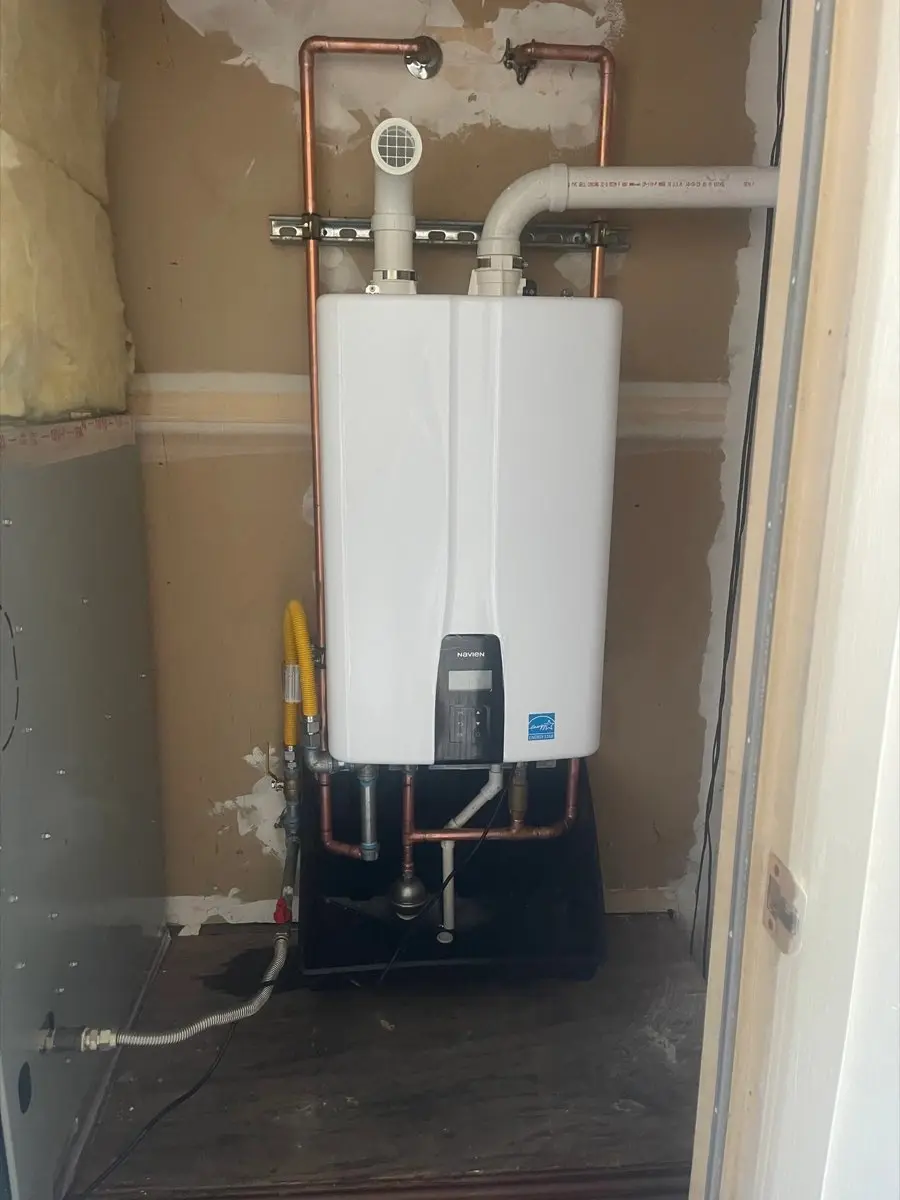
We install and repair both types every week across Sonoma and Marin County. Here is the math we walk through with homeowners at the kitchen table.
Quick comparison
| Factor | Tank (40 to 50 gallon gas) | Tankless (condensing gas) |
|---|---|---|
| Installed cost | $1,500 to $3,000 | $3,500 to $6,500 |
| Lifespan | 8 to 12 years | 15 to 20 years or more |
| Efficiency (UEF) | 0.60 to 0.65 | 0.90 to 0.96 |
| Hot water supply | Runs out, then recovers | Endless, capped by flow rate |
| Space | Floor unit, about 2 ft by 5 ft | Wall hung, suitcase size |
| Maintenance | Flush and anode check every 1 to 2 years | Descale every 6 to 12 months here |
| Best for | Tight budgets and simple swaps | Long stays, tight spaces, high demand |
Upfront cost: the tank wins
A like for like tank swap in Sonoma and Marin County typically runs $1,500 to $3,000 installed. That covers a 40 or 50 gallon gas tank, new connectors, seismic strapping, a drain pan where required, and the permit.
A gas tankless installation typically runs $3,500 to $6,500. The unit itself is $1,500 to $3,500. The rest is work a tank swap does not need. Upsizing the gas line from 1/2 inch to 3/4 inch usually adds $800 to $1,500. New venting adds $600 to $1,200. Condensing units also need a condensate drain. Full numbers are in our water heater replacement cost guide.
Operating cost and efficiency
Efficiency is rated by UEF (Uniform Energy Factor). Higher is better. A standard gas tank runs about 0.60 to 0.65. A condensing tankless like the Navien NPE-2 series hits 0.95 or 0.96.
The gap comes from standby loss. A tank keeps 40 to 50 gallons hot around the clock, even while you sleep or travel. A tankless burns gas only while a tap runs. The Department of Energy puts tankless at 24 to 34 percent less energy use for homes using up to about 41 gallons of hot water a day, and 8 to 14 percent for heavy users around 86 gallons.
In dollars, Energy Star estimates about $95 a year in gas savings for a family of four. Real, but modest. Efficiency alone does not pay for the conversion. The lifespan math is what closes the gap.
Lifespan and maintenance
A gas tank lasts 8 to 12 years here, and most fail by rusting out from the inside once the anode rod is gone. A tankless lasts 15 to 20 years or more because every major part can be replaced. Navien backs residential heat exchangers for 15 years.
The catch is maintenance. Water in Sonoma and Marin County carries roughly 7 to 10 grains per gallon of hardness. Scale builds on a tankless heat exchanger and chokes performance. Plan on a descaling flush every 12 months, or every 6 to 9 months on well water. Skip it and a tankless can die as young as a tank, and scale damage is not covered under warranty. Tanks want care too: a flush and anode check every year or two.
Space and placement
A 50 gallon tank is about two feet across and five feet tall, plus clearance. A wall hung tankless is roughly 28 by 17 by 12 inches, about the size of a carry on suitcase, and it frees the garage corner or hall closet. In our mild climate, outdoor rated units can hang on an exterior wall and give the space back entirely.
Flow rate vs recovery
A tank does not care how many fixtures run at once, until it empties. A 40 gallon gas tank delivers about 70 gallons in its first hour, then needs roughly an hour to recover. Teenagers can beat it.
A tankless never runs out, but it caps how much can run at the same time. A 199,900 BTU unit makes 11.2 gallons per minute when incoming water is warm. In a North Bay winter, with groundwater in the low 50s, the same unit makes about 5.6 GPM. Showers draw 2 to 2.5 GPM each. Two showers at once are fine. Add the washing machine and someone gets lukewarm. Sizing the unit to the household is the whole job.
What we recommend for Sonoma and Marin homes
The housing stock decides more than the brochure does. Much of Rohnert Park, Santa Rosa, and Novato went up between the 1950s and 1980s with 1/2 inch gas lines sized for a 40,000 BTU tank. A tankless can pull 199,900 BTU, so most conversions here include a gas line upsize. Budget for it up front.
Slab built Eichlers around San Rafael, Terra Linda, and Marinwood have no crawlspace, so pipe and vent routing is limited. A wall hung unit on an exterior wall, or an outdoor rated unit, is usually the clean answer. Tight crawlspaces in older Petaluma and Sebastopol homes add labor hours to the gas work, not impossibility.
Long single story ranch layouts wait a long time for hot water. A recirculation setup fixes that, either built into the unit (Navien A2 models) or with a crossover valve at the far bathroom. See our Navien page for the options we install.
A tank still makes sense when the budget is tight, the home is a rental, or you plan to sell within a few years.
Bottom line
Pick a tank for the lowest upfront cost and a simple swap. Pick tankless if you plan to stay 10 or more years, want the space back, or keep running out of hot water. Either way, have the gas line and venting checked before anyone quotes a number. We install and service both, and we repair what you already own. Call (707) 308-5599 or request a quote.
Frequently asked questions
Free Homeowner's Guide
The Sonoma & Marin Homeowner’s Plumbing Guide
Spot problems before they flood, find your shutoffs, and see real 2026 cost ranges. A free PDF, straight from a licensed local plumber.
- 5 signs to call before it floods
- Where your three shutoffs are
- Real 2026 cost ranges for the big jobs